Newsreel Tonwoche №482 (1939)

Reel 1
0:08:55
Reel 2
0:09:20Tonwoche №482 (1939)
Reel №1
Germany.
A propaganda sketch about recruitment.
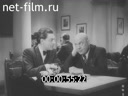
A young man sits in a cafe, waiting for Ludwig.
An elderly man, Ludwig, quickly enters the cafe, tells his friend that he was in a hurry.
Seeing the unknown man, Ludwig shields himself with a newspaper and says that this guy seems to be following him, perhaps to recruit him.
The young friend reassures Ludwig that the government will take care of him.
Japan. 20,000 students gathered for naval maneuvers.
Warships at sea, cadets at guns.
Anti-aircraft guns prepare to repel an air attack.
Landing of troops on the beach is practiced.
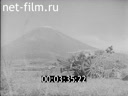
Horse artillery gallops against the backdrop of Mount Fuji.
Artillerymen prepare cannons.
Infantry attack.
Military training of the Hitler Youth.
The Hitler Youth detachment marches with a song.
The guys in formation, close-up of their faces.
Classroom training, instructor conducting training on a model rifle.
Shooting at targets outdoors and indoors.
Germany.
Classes in a kindergarten.
Children play educational board games.
Germany.
A model giant pig farm, workers prepare feed from waste in barrels, pour it out for the animals.
Pigs leave the pigsty and go to the field.
Women work in the cowshed, they turn over the hay, feed bran to the cows, milk them.
Removing manure to the fields, plowing with horses.
Keywords
Germany, 1939, propaganda plot, recruitment, Japan, 1939, World War 2, students, maneuvers, Navy, artillery, Germany, 1939, Hitler Youth, military training, Germany, 1939, children, kindergarten, Germany, 1939, agriculture, pets
Reel №2
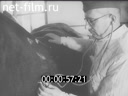
Despite the modernization of the army, horses still play a large role in some branches of the armed forces.
Stables for horses of the motorized artillery of the German Wehrmacht.
Soldiers lead the horses out, harness them in groups of 3. Veterinarians monitor the health of the animals, the horses treat a sore leg with ointment, walk around the horses in the stable, and conduct an examination.
Germany.
The release of military news sheets in the printing house, the headlines of the new newspaper.
The newspaper is created from materials sent from the front, and is distributed from the west to the east.
Typesetting on a typewriter.
Typesetters with font, newspaper sheets go in a machine.
A worker looks at the finished newspaper.
Newspapers are packed in bundles of 500 pieces, loaded.
The Western rampart.
General Todt inspects work processes at the construction of defensive structures on the Baltic Sea, he walks around the line of workers.
An armband with the inscription: "org.
Todt". 200 German and Polish workers have been working on the construction for 6 months already.
Polish workers being awarded for their work.
North Sea. 76 English ships are blockaded in a German harbor.
The German fleet carefully guards its borders.
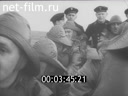
Border boats patrol the North Sea, stopping a ship.
A German officer and sailors are transported in a boat to an English ship, climb on board, and check documents.
A view of various foreign merchant ships being checked by German border guards.
Poland.
Volksdeutsche arrive by steamer in the conquered regions of the Baltics and Poland to new places of residence, fulfilling the call of the Fuhrer, expressed in his speech of October 6, 1939, to provide German settlers with the captured eastern territories.
People on deck with belongings.
In the port, boxes, carriages, horses, etc. are being loaded.
Arrival in the Baltics, families are met and fed.
Women from the Red Cross help the settlers.
Issuance of housing documents and Ausweis to those arriving.
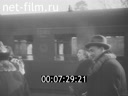
Posen (Poznan) train station, people get off the train, Wehrmacht soldiers meet them, help them.
Registration of people who have arrived.
Young people answer a questionnaire, receive documents for work in their specialty.
A Volksdeutsche family arrives in a cart to a farmstead, inspects their new farm.
Cows graze.
Geese swim in a pond.
Keywords
Germany, 1939, World War 2, pets, artillery, soldiers, veterinary science, Germany, 1939, World War 2, press, typography, Germany, Western rampart, 1939, state, figures, personalities, inspection, construction, defensive structures, North Sea, 1939, World War 2, Navy, civil fleet, blockade, Poland, 1939, World War 2, Volksdeutsche, civil fleet, Red Cross, migrants, agriculture